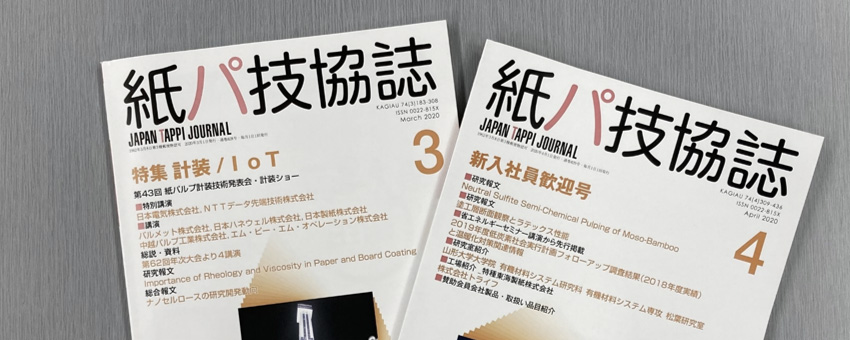
JAPAN TAPPI JOURNAL February
2008
Vol.62 No.2 Abstracts
Point of Paper Container Processing Technology
Hiroshi Katayama
Technical Headquarters Development DepartmentCKyodo Printing Co., Ltd. Abstract
We are developing a new package technology. The paper container is a packaging
material that is from of old. The paper container is made from the paperboard
and has some features as a thing that contents can be defended from a strong
impact from the outside and a beautiful print are possible etc. Moreover,
it starts receiving the fair wind like a noteworthy rise to recent environmental
problems and the revisions of the container recycling law, etc. and it entering
a new stage. It wants to look back on the processing technology of the paper
container, and to clarify the function of the paperboard requested from the
paper container processing. And, I want to tie to the development of a new
package.
A Skit Packer and Finish Facilities
Hideyuki Watanabe
Designing Dept., JTEC Co. Abstract
A finishing machine to wrap with recyclable paper in the paper industry world
is reviewed by global environmental protection and utilization activity of
resources. Own way company sells a design and production of an industrial
machine making a paper manufacture finishing machine main, mainly. It is
thought that packing with paper is disadvantageous in a tear and absorbency
of packing in comparison with stretch packing and shrink packing of film
system a little. However, sale number of packing facilities increases from
development of damp proofing paper of paper manufacture maker, improvement
of quality and stability of a packing process of packer maker surely year
by year. It is own way company, but inquiries about a skit packer increase
and the delivery results increase recently, too. It is thought that possibility
of skit packer sales promotion is big, even if I think from a share only
for Japanese soil. Therefore Ifd like to explain a skit packer and the finish
that original, own company.
Operating Experience of Semi-automatic Ream Feeding System
Tsukasa Futo
Finishing charge Finishing section P-com. Co., Ltd. Abstract
P-com. Co., Ltd. is in charge of sheet finishing operations such as roll wrapping,
sheet cutting and wrapping of paper sheets for Nippon Daishowa Paperboard
Tohoku Co., Ltd. In the sheet finishing process, a ream feeding work by hand
is very hard and there are many kinds of works. Although it is difficult
to mechanize the process of a ream feeding, an automatic ream feeding has
been required for cost reduction in this process. So we have solved such
problems by development of semi-automatic ream feeding.
In this paper, an operating experience and a development of Semi-automatic
Ream Feeding System are introduced. After installing the system, we have been
released from hard works and engaged in observing the sheet finishing process.
The Semi-automatic Ream Feeding System was developed by Nippon Daishowa Paperboard
Tohoku Co., Ltd., P-com. Co., Ltd. and SERVOARM Co., Ltd.
Introduction of Updated Roll Wrapping and Handling System
Masashi Shibaki
Itochu Sanki Corporation Abstract
Recently, the demand for roll wrapping and handling are becoming
tough and diversified, not only for protection against humidity,
tear up, dirt but also for operating efficiency, small lot
and various kind. In order to satisfy those requirements, RCS
(Roll Care System) has been specializing in only roll wrapping
and handling for more than 35 years. This article mentions
the latest roll wrapping and handling system through RCS technologies
and products.
Operating Experience of Automatic Coil Wrapping Machine
Masayuki Saito
Nakoso Jujo Paper Industrial Corporation Abstract
CCP (Carbonless Copying Paper), produced in Nippon Paper Industriesf Nakoso
mill, is sensitive to pressure. Because of this, rolls of CCP had been manually
packed in corrugated cardboard boxes to protect them from the bruises in
the transportation. As the production volume grows, manual packing is no
longer efficient. Therefore the semi-automatic wrapping machine using plastic
stretch film was adopted. With the raising concern over environmental issues,
recently our customers have a serious problem with the disposal of the plastic
film used for CCP packing. We have developed the new original wrapping paper
to eliminate this problem. The features of this wrapping paper are as follows:
using no plastic film, recyclable, shock absorbing, damp proof, etc. With
this new wrapping paper we have started the exceptional full-automatic wrapping
machine for CCP, which has an automatic labeler, a palletizing robot, etc.
In this report the characteristics of our new original wrapping paper and
our operation experience of the full-automatic wrapping machine are presented.
An Application of AS/RS to Paper Mills
Tsukasa Oohashi and Yousuke Suga
Ishikawajima-Harima Heavy Industries Co., Ltd.
Abstract
AS/RS systems enable to reduce the handling work, to improve the efficiency
of storage and to computerize the stock control. These characteristics
can automate the intermediate buffer storage between two processes
as well as store the products before delivery.
This paper presents the examples of AS/RS applied to finishing process
of paper mills.
GL&V/Kawanoe Zoki-Innovative Cooperation
@-Pulp Processing Equipment (Celleco, Impco, etc), BTF Headbox System-
Junichi Yano, Kozo Kishida and Seiichiro Utatsu
KAWANOE ZOKI CO., LTD.
Abstract
The delivery record of BTF dilution system has been delivered to a total
of 8 systems since Kawanoe Zoki started to manufacture and sell it
under license from GL&V in Japan. All those are BTF system retrofit
to the existing headbox without any rebuilding. The results are notable
improvement in paper quality such as CD-BD profile and contributing
to productivity enhancement such as wider sheet width and shorter grade
change time than that of before.
Kawanoe Zoki deals in not only Paper machine technology but also technology
in chemical pulping. We introduce Celleco Twister cleaner developed for
energy saving and world-renowned Impco Hi-Q Knotter and Screen. In addition
we show Compact Press and the relational equipment from our new business
line of chemical pulping line which is consist of cooking, washing, oxygen
delignification and bleaching, which have been developed by former Kvaerner.
Effects of the Air in Stock at Paper Production and On-line Air
Content Analyzer
Takeshi Hanaoka
Savcor Japan K.K.
Matti Hakkinen
Savcor Process Oy
Abstract
Increasing production rate and requirement for quality, efficiency
and environmental load make higher attention on entrained air
and its detrimental effects on the paper making process.
The air content measurement principle introduced here is based
on attenuation of ultrasound by air bubbles. This ultrasound
method is a continuous, on-line measurement which can provide
optimal control of de aeration, trouble shooting as well as process
development.
Retention Aid for Fillers Using in the Process of Deinked Pulp
Manufacturing
Kazushige Inaoka
Research & Development Dept., Paper Chemicals Division, Harima
Chemicals, Inc.
Abstract
An inorganic particle called filler is added to printing paper
for the purpose of improving optical characteristics and printability
of the paper. However, the most of fillers are detached from
pulp to water in the process of deinked pulp manufacturing,
and it becomes the industrial waste in drainage process.
In such a situation, we started our research based on a concept
to reduce the amount of waste in the drainage process, and developed
gretention aid for fillers using in the process of deinked pulp
manufacturingh. We think that this development could improve
the retention of fillers dramatically compared with other coagulant
and flocculant due to a formation of ionic macromolecule and
an improvement of the interaction between this chemical and fibers,
fines and fillers. In this report, we introduce a characteristic
and an effect of this chemical with showing application results
at the actual machine.
The Cartridge Mechanical Seal for Pulp & Paper
Plants
Hidekazu Takahashi
Customer Service Dept., EAGLE INDUSTRY Co., Ltd.
Abstract
In a pulp & paper plant, many numbers of varieties
of pumps are utilized such as water pumps, pulp
pumps and chemical pumps all through the production
processes from digesting to painting. Recently,
a mechanical seal has been selected as a standard
sealing device for such pumps. A cartridge seal
is coming into wide use for work improvement, for
being easy to handle and for installing correctly.
And then the cartridge seal is used not only non-flushing
use but non-cooling use in a plant. Additionally,
the cartridge seal with emergency seal is developed
for pulp pumps. When a mechanical seal doesnft
work and leakage starts, the emergency seal installed
in the cartridge seal works and can use for a certain
period. I will introduce the latest technology
trend about the cartridge mechanical seal for the
pulp &paper plant.
Performance and Function Requested for the Flaw
Inspection System
@- MaxEye. Next and MaxEye. REVO -
Yoshinobu Sugino
Strategic Planning Group, FUTEC INC. Abstract
FUTEC INC. has sold around 5,500 Inspection Systems
to such Paper Pulp Industry, Film Industry,
Nonferrous Metal Industry, Non-woven Fabric
Industry and Printing Industries, etc. for
30 years. FUTEC INC. developed two of the new
Inspection Systems based on the know-how that
has been cultivated and the needs/ wishes obtained
from the market. One is MaxEye. next which
is possible to correspond to the lines of various
specifications flexibly. Another is MaxEye.
REVO which the detection ability of faint line
irregularity/unevenness was strengthened. FUTEC
INC. makes the best proposal by two models
to satisfy the demand of the diversified customers.
kajaaniWEM & kajaaniRM3
@- The Most Modern Solutions for Paper Making
Process -
Jukka Nokelainen and Takeshi Sato
Process Automation Systems Division, Metso
Automation
Abstract
This paper introduces two lately launched
superior tools for wet end management:
modular multi talent analyzer and consistency
sensor. The consistency sensor is stand-alone
device that performs continuous measurements
from one sample point. It is ideal for
applications that require continuous total
and true ash consistency measurement and
automatic control. The new analyser is
first in the world that provides papermakers
with all the right and relevant wet end
measurements. Here we describe by several
living examples of charge, redox, pH, conductivity,
temperature and consistency measurements,
how to get comprehensive understanding
over paper making and point out process
problem areas and find right actions to
correct them.
Estimation of Timber Volume in Eucalyptus
Plantations Using Satellite Images
Toru Katsura
Corporate Planning Department, Mitsubishi
Paper Mills Ltd.
Pranab J. Baruah, Takahiro Endo and Yoshifumi
Yasuoka
Institute of Industrial Science (IIS),
The University of Tokyo
Abstracts
Accurate estimation of timber volume
in commercial plantation can serve
the industry as well as the environment
than sustains them. A robust estimation
methodology will help the plantation
industry to efficiently manage this
costly and long term investment to
get the utmost return. Here, we investigated
an approach to estimate timber volume
in several Eucalyptus globulus plantation
plots of varying ages in Chile.
Empirical relationships between temporal
satellite imageries (Landsat ETM+) derived
spectral feature and timber volume were
investigated. A total of 12 Landsat ETM+
scenes, both radiometrically and geometrically
corrected, were selected to match with
the dates of ground truth allometry data.
Landsat ETM+ has a ground resolution
of 30 meters with a swath width of 185
km and visits the same position of the
earth every 16 days making it suitable
for monitoring plantations throughout
a longer period of time with reasonable
costs. Allometry data from a total of
8 plots spanning over four years (1999
`2004) were used. The area of the plots
ranged from 30 to 150 ha and trees were
planted between year 1992 and year 2000.
Allometry data included diameter at breast
height (DBH), height of tree (H) of individual
trees at selected subplots (0.02 ha)
within each plot, collected by plantation
management staff.
Mid-IR band 5 of ETM+ followed by the
green band of ETM+ has the strongest
correlation with timber volume for our
study area. Out of several vegetation
indices, Specific Leaf Area Vegetation
Index (SLAVI), which uses mid-IR band
5, showed strongest linear relationship
with volume. The best relationship was
used to estimate total volume in each
plantation plot and to produce spatial
volume map. Comparison between total
estimated volume and actual observed
volume at each plot showed the estimation
accuracy was considered satisfactory.
Spatial maps could be of importance for
efficient forest management.
Keywords: plantation, timber volume,
satellite, Landsat, vegetation index
TOF-SIMS Analysis of the Bleeding of
Organic Compounds to Pulp Fiber Surface
Hiroto Higashi, Toko Nakamura and
Masayuki Omatsu
Material Analysis Center, Oji Paper
Co., Ltd.
Abstract
It was commonly found that the aging
and the manufacturing conditions
were influenced on the surface properties
of the paper. We assumed that the
change of the surface properties
was caused by the bleeding of the
low-molecular-mass compounds to pulp
fiber surface. In order to confirm
this assumption we carried out the
surface analysis of handsheets using
XPS and TOF-SIMS.
A handsheet was prepared from a hardwood
pulp. TOF-SIMS and XPS analysis showed
that the bleedable compounds, such
as C-C chemical bonds increase on the
surface of the sheet at high temperature.
Keywords:
bleeding, pulp, surface analysis, TOF-SIMS,
XPS |
|