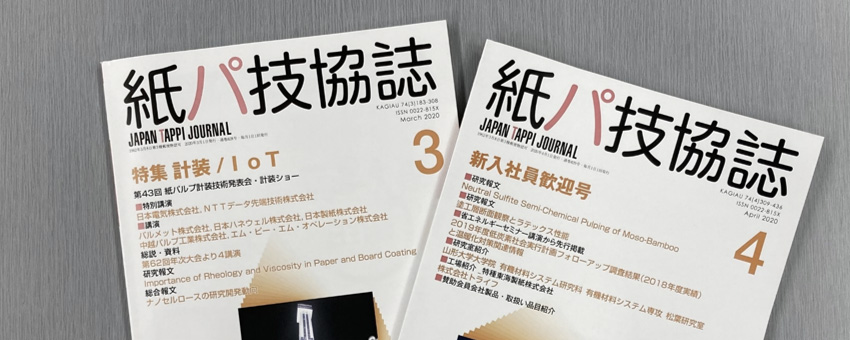
JAPAN TAPPI JOURNAL April
2008
Vol.62 No.4 Abstracts
Mass Production of Eucalyptus globulus Elite Trees in Western Australia
Keiichi Shimizu
Forestry Science Research Laboratory, Nippon Paper Industries Co., Ltd.
Abstract
Nippon Paper Industries has developed the clonal propagation technology of
E. globulus by tissue culture to supply a high yield, quality, survival rate
and uniformity for plantation purposes. Selection of E. globulus tree, which
were excellent in growth and tolerance to aridity, was performed in Western
Australia. Trial mass production was done by using these elite trees and elite
tree candidates.
In tissue culture, red light by the Cold Cathode Fluorescent Lamp was used
as a new light that changed into current fluorescent lamp. The rooting term
and the growth term were shortened by using this.
For the difference of growth by the quality of the soil and the planting density,
trial plantations of clones were started in Western Australia.
Development of Reforest Technology Giving Environmental Stress Tolerance to
Tree
Takayuki Asada
Forestry Research Institute, Oji Paper Co., Ltd.
Abstract
This theme aim at the development of the afforestation technology that
reforest the region where the environmental stress is severe by the method
of the environmental stress tolerance handily given to the tree according to
fertilizing and/or chemical spray. Cytochrome P450 inhibitor such as Uniconazole-P
gave the environmental stress tolerance to the eucalyptus. Uniconazole-P that
showed the environmental stress tolerance giving action inhibited the metabolic
speed of the abscisic acid which controls the environmental stress response.
Uniconazole-P processed (0.025mg/plant) eucalyptus showed the stress tolerance,
and the amount of initial (3.5 months) growth (dry weight) of plant under strong
light environment increased to 1.5-2.3 times that of the control experiment.
Uniconazole-P is a compound with high safety, which is registered as an agricultural
chemical in Australia, and immediate effect for practical use would be expected.
Development of Energy-saving Flotator
Shintaro Sasada
Pulp Division, Tomakomai Mill, Oji Paper Co., Ltd.
Abstract
The rate of using waste paper exceeds 60% in 2003, and in order to raise it
continually, we should expand the utilization of paper instead of board. Therefore,
it is important to improve quality of deinked pulp and to save energy of deinking
system. A flotator is one of the major deinking processes, which spends a lot
of energy. In this presentation, the development of new flotator with reduced
energy consumption is reported.
One of the features of the conventional OK-flotator is its cell structure
enabling high efficiency of deinking. On the basis of this cell structure,
we focused
on two important factors of deinking to reduce energy consumption; the contact
of bubbles and pulp slurry, and the separation between bubbles and pulp slurry.
The new flotator has structure which enables pulp slurry to contact with plenty
of bubbles that are filled in a particular area, and stabilizes both upper
region of slurry and froth layer. And it has three rooms to increase the contact
and the separation. As a result, this new flotator realizes the 60% reduction
of both the energy consumption and the volume, compared to the conventional
OK-flotator.
Liner Machine Operational Experience of Octopus CP Control
Takaaki Abe
Kitakami Paper Co., Ltd.
Abstract
We introduced an Octopus System of Kobayashi Engineering Works, Ltd. as 1st.
practical system in Japan for the purpose of improving the basis weight profile
in cross direction and shortening the adjustment time required. All system
is excellently running at present. We report the operational experience of
this system since the start-up.
Combustion Improvement of Recovery Boiler
Kenji Nozaki
Ebetsu Mill, Oji Specialty Paper Co., Ltd.
Abstract
No.5 boiler of Oji Specialty Paper, Ebetsu Mill, Japan is a main recovery
boiler in the mill, and was modified for Performance improvement since its
construction of 1972.
For the reason of high cost of oil these years, further energy conservation
becomes urgent top priority subject for us.
We installed well proven Stacked Air System (SAS) of Anthony Ross (USA) to
our No.5 Boiler in Oct. 2006 for combustion improvement and energy saving,
which was the first trial in Japan.
The result was to our full satisfaction in the various respect such as Economical
merit, Increase of Through put, Reduction of Carry over Rate, Excess O2 Reduction,
Improvement of Thermal Efficiency, Improvement of Steam production/Black liquor
Ratio, Reduction of Air Heater Steam, Reduction of Soot Blower Steam Consumption,
Improvement of Chemical Reduction Efficiency, Reduction of Burnable Gas, Less
Emission/TRS and Prolonging of Run time.
The installation work could be completed within the shut down time of 11days.
We would like to introduce our experience about the combustion improvement
work with SAS, including the economical effect and the outline of the modification
of the system. Operating Experience of Biomass Power Plant
Norikazu Baba
Kanto Mill (Katsuta), Hokuetsu Paper Mills, Ltd.
Abstract
Our Kanto Mill Katsuta division is located in the north in Ibaraki prefecture.
Number 1 power plant of the fuel oil use which is being operated since factory
establishment up to now was doing energy supply by only one system. Introduction
of new equipment was also urgent business as a production cost measure in addition
to shake from production activities of CO2 reduction and fossil fuel dependence.
Necessity in the energy plant where more correspondence to working old replacement
of facility and the use energy with the factory production amount rise increase
is tight and new than the factory establishment time has occurred.
The form of "thermal recycling" for which a demolition wood is utilized
as fuel as well as the "material recycling" which uses a recycled paper
for a cardboard raw material from the past are complete by this biomass power
plant, and the value as the resource circulation type factory is going to rise
more.
It's introduced about experience from introduction to commercial operation.
Energy Saving Case of Waste Water Treatment Facility
Eiichi Aisa
Fuji Mill, Oji Paperboard Co., Ltd.
Abstract
Nowadays, environmental destruction, especially the global warming caused
by the increase of CO2 emissions, has been one of the biggest problems in the
world, and to make proactive energy-saving efforts is the important issue for
paper industry as a heavy energy-consumer.
While active and effective measures has been taken for production line and
power generating unit where large amount of energy is required, adequate measures
has not been taken for effluent treatment facility.
There were aeration route blowers for bio-treatment installed in the effluent
treatment facility, however, route blowers had problems of high electric power
consumption, noise, and vibration, and countermeasures to improve such circumstance
were required urgently.
I would like to introduce how we achieved to save electric power and to reduce
environmental load by replacing the route blowers with K-TURBO’s HIGH-EFFICIENT
TURBO BLOWER.
Development of New Generation Newspaper, “PlusNews”
Hiroshi Shimase
Tomakomai Mill, Oji Paper Co., Ltd.
Abstract
New media such as Internet have significant impact upon Japanese newspaper
industry these days. Newspaper publishing companies are trying to increase
color pages in their newspaper to secure more customers who expect the greater
effect in their advertisement. Oji paper has moved forward to R & D with
a rapid improvement on color printing quality compared with standard newspaper.
A couple of novel technologies, such as “Super White Carbon” and “Fine Plus
Coat” have successfully developed. White Carbon (Hydrous Silicic Acid) is an
effective filler which prevents print through. “Super White carbon”, manufactured
in controlled conditions, has superior performance to the conventional one
with less addition ratio. “Fine Plus Coat” remains ink on the surface of the
paper and is able to obtain greater printing quality compared with standard
newspaper.
New generation newspaper “PlusNews” consists of these two key technologies
to achieve extreme printing quality and was brought to market officially last
fall. Half of the production of Oji’s newspaper has already been replaced from
conventional newspaper to “PlusNews” as of June 2007, and replacement would
be completed by the end of this year.
Development of Lightweight Coated Paper for On-demand Printing
Hisahiro Omote
Nippon Paper Industries Co., Ltd.
Abstract
The market of on-demand printing in printing industry is expanding these several
years. In recent years, with high speed on-demand printing machine of electrophotography
that utilizes flat sheet, the opportunity to print on coated paper is increasing.
Furthermore, the requirement for lighter coated paper is getting stronger.
However, coated paper, especially light coated paper with low stiffness, led
problem of poor runnability because coated paper was easy to stick to toner
transferring part and toner fixing part within printing machine compared with
wood-free paper.
In order to solve this problem, light weight coated paper for on-demand printing
was developed by mixing a new stiffness improving reagent (Polyacrylamide)
with good coating aptitude to coating color. This light weight paper for on-demand
printing combines the good on-demand printability (printing quality, runnability)
with the excellent offset printability, and is also designed to provide the
easy-of-use by operator.
Development of Hydrothermal Reaction Solidification of Paper Sludge Ash
Hirotoshi Takeya, Toshiyuki Nago and Masahiro Sasaki
Kushiro Mill, Nippon Paper Industries Co., Ltd.
Abstract
Paper sludge is mainly the waste of de-ink pulping plant and is burned in
sludge boiler to recover energy and to reduce its volume. Sludge boiler ash
is utilized as the raw material to produce cement, but the amount of sludge
boiler ash increases due to the increase in the capacity of de-ink pulping
plant. Therefore it becomes more and more important to develop other processes
using sludge boiler ash as raw material.
Recently, we have developed a harmless product by hydrothermal reaction solidification
of boiler ash and have been making an effort to enlarge the usage of this new
product.
A Report on 2007 TAPPI Engineering, Pulping & Environmental Conference
(2007 EPE Conference)
Iori Tomoda*1, Shinichi Onogi*2 and Hiroshi Araki*3
*1Oji Paper Co., Ltd.
*2Nippon Paper Industries Co., Ltd.
*3Japan Pulp and Paper Research Institute, Inc.
Abstract
The 2007 Tappi EPE Conference was held on October 21-24, 2007 in Jacksonville,
FL, USA. The 435 people from 17 countries including Japan, Sweden, Finland,
Brazil, China, Canada and USA, participated in the conference. The 101 papers
including two Japanese papers were presented in 51 sessions. The topics of
engineering, puling and environmental divisions of the conference were reviewed
in this report.
Effects of Cooking Conditions on the Bleachability of Bamboo Kraft Pulp
M. Sarwar Jahan, D. A. Nasima Chowdhury and M. Khalidul Islam
Pulp and Paper Research Division, BCSIR Laboratories
Abstract
The bleachability of kraft pulp from wood has been the subject of several
reports, but little effort has been made to assess the bleachability of nonwood
pulp.
This study evaluated the cooking conditions, such as active alkali charge,
cooking time and sulphidity on the bleachability of bamboo kraft pulp. We cooked
bamboo chips to kappa number around 20 by alternating cooking variables. We
then quantified pulp yield, and evaluated pulp quality through measuring unbleached
brightness, viscosity, pentosan, ?-cellulose and phenolic hydroxyl group (PhOH)
content in the residual lignin of pulp. Pulp produced at higher active alkali
charge and sulphidity had higher pulp yield, higher ?-cellulose, viscosity
and lower pentosan in pulp and higher PhOH content in the residual lignin.
After oxygen delignifying the pulp, bleaching was done by DED or QPP sequence.
Degree of oxygen delignification had no relationship with the cooking conditions.
The bleachability of pulps was determined by measuring consumption of chlorine
dioxide to attain 80 % brightness level. The bleachability of pulp was improved
when pulping was done in higher active alkali charge and sulphidity. The bleachability
of bamboo kraft pulp showed a direct relationship with PhOH content in the
residual lignin.
Keywords: Bamboo pulp, active alkali, Suphidity, Bleachability,
Brightness, Phenolic hydroxyl group
Development of Manufacturing Process for High Quality Calcium Carbonate by
Causticizing Process in a Kraft Pulp Mill (Part4)
- Investigation of Continuous Reaction for Rice-like Particles -
Yasunori Nanri, Haruo Konno and Hideyuki Goto
Pulp and Paper Research Laboratory, Nippon Paper Industries Co., Ltd.
Yasuhiro Okamoto
Ishinomaki Mill, Nippon Paper Industries Co., Ltd.
Kazuto Takahashi
Gotsu Mill, Nippon Paper Chemicals Co., Ltd.
Abstract
Precipitated calcium carbonate is produced as a by-product in the causticizing
process of the kraft pulping process. There are many advantages to use this
by-product, causticizing calcium carbonate (CCC), as filler and coating pigment
in paper. By using this CCC for paper materials, lime-kiln operation would
be reduced or eliminated, resulting in the reduction of fuel oil for calcination
of calcium carbonate. Furthermore, accumulated impurities in the lime cycle
can be removed constantly. In our previous reports, we showed that CCC particles
with a various kind of morphology were obtained by separating and precisely
controlling the two reactions of slaking and causticizing in the causticizing
process. Among these morphologies, rice-like particles can be produced with
the least process modification. Thus, the production trial of rice-like particles
at mill scale was done and then the industrial production of the rice-like
CCC was succeeded. However, this production process was based on the batch
reaction. Continuous reaction is preferable compared to batch reaction in industrial
process. Therefore, in this report the production trial of rice-like particle
by continuous reaction at laboratory and mill scale plant are carried out.
We found that rice-like particle with low wire abrasion ratio can be produced
at mill scale plant by controlling the residence time of slaked lime slurry
and green liquor at first causticizing tank. Moreover, filtration properties
of CCC are also improved by the additional feeding of slaked lime slurry and
green liquor to #3 tank.
Keywords: Causticizing reaction, calcium carbonate, continuous reaction,
mill trial |
|