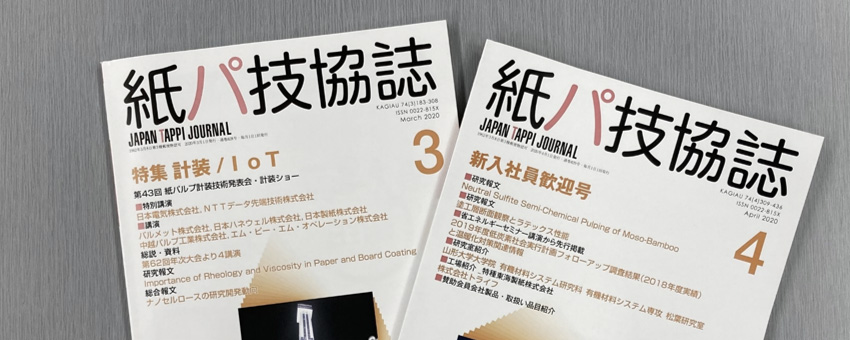
JAPAN TAPPI JOURNALVol.
58, No.10
October 2004 Abstracts
The Proposal to Association Activity: Aim at Base Strengthening of
an Association
JAPAN TAPPI
In 1994, a project team has submitted to the board of
directors "The
Guideline for the 21st Century: the report entitled "aiming
at training of the engineer who bears the next generation, and higher
technology". Then, it has worked according to the recognized
report. The proposal was again looked over by leading the Junior
Steering Committee in 1998. As a result "The Guideline for the
21st Century: aiming at the further development" was submitted
anew. Henceforth, activity has been promoted that this proposal should
be materialized. Since five years were passed after that, while the
Junior Steering Committee takes the lead and summarizes activity
in the meantime again, in order to strengthen the base of JATAN TAPPI,
the report about a new action policy was submitted to the board of
directors in June, 2004, and it was recognized.
Troubleshooting Activated
Sludge Problems
Rick Marshall Marshall Environmental Training & Consulting Group
Hidesato
ShimotoNovozymes Biologicals Japan Ltd.
Operating treatment systems
for the pulp and paper industry can be quite challenging considering
that treatment regulations are getting
more stringent and mills are changing their operations. The mill
operation changes have changed wastewater characteristics and the
loadings to previously successful operating plants. The result is
that some existing treatment plants cannot consistently meet their
effluent discharge permit.
Success or failure in activated sludge
systems depends on growing a biology that has good settling characteristics
that will produce
a quality final effluent from the secondary clarifier. There are
many problems that can occur in activated sludge systems such as
poor settling and foaming. This paper discusses these problems by
listing possible symptoms for each problem, the potential causes
and the methods available to correct or control the problem.
MC Series
of Bacterium Products for Troubleshooting in Activated Sludge Processing
Hideomi
Matsuoka and Takuji Yamamoto
Ichihara Laboratory, Seiko PMC Corporation
The extraordinarily large
amount of the industrial water is used in the pulp and paper industry
among major domestic industries. It
is discharged through the process in the secondary treatment such
as bio-treatment process. Therefore, the wastewater treatment at
the bio-treatment processing in the pulp and paper industry is an
important theme. Although bio-treatment processing is a popular method,
many factories are facing problems at wastewater treatment with several
factors, such as increase of load and process fluctuations. Moreover,
since it is assumed that the regulation for effluent standard becomes
stricter due to consideration of environment issues, the demands
for the improvement on capability and stable operation for bio-treatment
processing are increasing year-by-year.
In these circumstances, we
have been applying products by the name of “MC Series” for Bioaugmentation.
The Bioaugmentation is the practice
to add bacterial preparations which have high growth capability into
the current bio-treatment process. The bacterial preparations in
MC Series have specific catabolic abilities which can degrade certain
components in the wastewater. Bioaugmentation can enhance the performance
of an indigenous biomass to respond against process fluctuation.
In
this article, it introduces the feature of MC Series, the results
of field tests and “MC + Chlorination processing” which is a new
method of filamentous bulking treatment. These results indicate that
the MC Series lineup meets the various requirements for industrial
wastewater treatment at pulp and paper industry. It is considered
that it can contribute to the pulp and paper industry on the reduction
for environmental impact.
Keywords: Bioaugmentation
Continuous measurement of Biochemical Oxygen
Demand by microbial BODs biosensor
Ryuzo Hayashi
Oji Scientific Instruments Co., Ltd., Osaka Office
BODs
biosensor, BF-2000, with immobilized microorganisms was developed
for measuring the biochemical oxygen demand in industrial wastewater.
BF-2000 is able to use even microorganisms in active sludge other
than Trichosporon sp.
Also BF-2000 is adopting antiseptic tubing
to prevent blockage by microbial contamination. BF-2000 is able to
equip wastewater sampling/dilution
system and data transmission systems to improve the performance.
The result that measured various kind of wastewater by using the
BODs biosensor is shown.
Keywords: BOD, Biosensor, immobilization,
microorganism, instrument, wastewater
Introduction of Mitsubishi Di-electric
Droplet Scrubber for Sub-Micron ParticleRemoval
Morio Kagami Mitsubishi Heavy Industries, Ltd.,
Kobe Shipyard & Machinery
Works
Machinery & Environment Plant Department
For oil fired boiler
plant, SO3 gas is cooled down forming very fine mists through wet
type flue gas desulfurization system (wet-FGD).
Therefore, removal of SO3 mists is very poor at FGD absorber, which
causes a long visible smoke from the stack. To overcome this problem,
installation of wet type electrostatic precipitator (wet-ESP) is
the most suitable, however this system is not widely used due to
the space limitation or expense.
An advanced gas cleaning system has
been developed, which incorporates the function of wet-ESP into wet-FGD.
This paper introduces the principle
of the new technology, along with the operational experience at the
commercial scale plant. This system is called Mitsubishi Di-electric
Droplet Scrubber (MDDS).
Biological Transporting Bed of Waste Water
Processing System (Ryu Ryu Bio System) for Paper Mill
Masayuki Ishikawa
Environment Plant Division, HYMO CORPORATION
Waste water from
paper mill is much quantity, but it is comparatively clean without SS. Requirement
for environment management increases
recently, and regulation about waste water becomes severe. On the
other hand, the quality of waste water from paper mill have taken
a turn for the worse due to request of paper recycle. And now paper
mill become to have new waste water treatment in order to prevent
water pollution. We have developed for 8 years a simple waste water
processing, that have Transporting Bed I called( Ryu Ryu Bio System).
I will show the history and feature of Ryu Ryu Bio System.
Paper Mill
Wastewater Treatment by Moving Bed Biofilm Reactor Using Sponge Media
Hiroshi
Sakuma
Environmental R&D Dept., Water Environmental Technology
Development Center
EBARA Corporation
The moving bed biofilm reactor using sponge media
has characteristics such as that can be operated with high load BOD
and easy maintenance.
Pilot plant tests using this reactor were conducted for paper mill
wastewater treatment. And so the performance of full scale moving
bed biofilm reactor using sponge media was investigated, modifying
an existing paper mill wastewater treatment plant.
In the pilot plant
test, S-COD was removed over 65% at COD volumetric loadings below
4kg/(m3・d), and S-BOD was removed over 90% at BOD
volumetric loadings below 3.5 kg/(m3・d). The moving bed biofilm reactor
using sponge media showed high performance of organic removal. Furthermore
this pilot plant effluent COD was removed about 80% by chemical precipitation
test, conducted with the addition of 200mg/L as Al2(SO4)3・18H2O and
1mg/L as anion polymer at pH 6. These results show that soluble and
particle organics is removed effectively by combined process of moving
bed biofilm reactor and chemical precipitation.
In the full scale
moving bed biofilm reactor, S-COD was removed over 70% at S-COD volumetric
loadings below 2 kg/(m3・d), about 60%
at S-COD volumetric loadings of around 3 kg/(m3・d),and S-BOD was
removed over 90% at S-COD volumetric loadings below 2.5 kg/(m3・d).
Performance of full scale plant was higher than designed value with
60% S-COD removal at S-COD volumetric loadings below 2.5 kg/(m3・d)
These
results show that high organic load treatment is achieved with the
moving bed biofilm reactor using sponge media for paper
mill wastewater, and this reactor is effective for improvement of
existing plant.
Keywords: Paper Mill Wastewater, Moving Bed Biofilm
Reactor, Sponge Media, High Organic Load
New Wastewater Treatment
System for Pulp and Paper Factory
Atsushi Nakano
Water Engineering Dept., Environmental System Div.,
Engineering & Environment
Group
Sumitomo Heavy Industries, Ltd.
The wastewater treatment system applied
to the pulp and paper factory is required to save space and to save
cost of construction and operation.
In this paper 3 systems which suits the requirement are introduced.
1)
BiobedR EGSB system is a high load anaerobic wastewater treatment
technology using the granular biomass. This technology has merits-high
organic loading capacity, low power consumption, less sludge discharge,
energy recovery from bio-gas.
2) Sumi-Sludge system is a space saving
wastewater treatment system. Sumi-thickener - High rate coagulation
and sedimentation system -
is combined to activated sludge treatment process.
3) The membrane
bio reactor (MBR) system applies submerged membrane units inside
of the aeration tank of activated treatment process.
The permeated water quality is very clear. This system is a high
space saving wastewater treatment technology.
Keywords: wastewater
treatment, anaerobic, EGSB, UASB, Coagulation and sedimentation,
Membrane bio reactor, MBR, Submerged membrane
Application of Oxygen
Activated Sludge Treatment(UNOX System) for Pulp and Paper Waste
Makoto
Ueda
Sales Department Environmental Business Headquarters
Showa Engineering
Co., Ltd.
UNOX system has been used in various fields as its unique
treatment process for years, and the number of installations reaches
over 130
plants in sewage and industrial waste treatment in which 35 plants
are for pulp and paper waste.
This process was developed in a leading
chemical company in USA. In Japan, Showa Engineering, which took
over Showa UNOX K.K, has
been marketing since introduction of UNOX technology, and has continously
advanced UNOX system with lots of experiences; especially for cost-reduction
of both construction and operation as well as for optimum design
conditions.
Since UNOX system uses high purity oxygen gas as aeration
gas instead of air, there are many advantages compared to a conventional
treatment
process.
Thanks to customer’s highly evaluation for UNOX system, the
large size treatment plants in pulp and paper waste have been mostly
UNOX
system. Besides, the expansion is to the existing plant are similarly
UNOX system. We are convinced that UNOX system is one of established
wastewater treatment process on its treatment performance as well
as economical process.
We, herein, have just made an evaluation of
UNOX system based on the past achievements in pulp and paper wastewater.
Keywords:
Usage of high purity oxygen, Energy-saving-plant
Solvent Exhaust Gas
Treatment Technology
Fujihiko Nakade
AC Operations Department, Toyobo Co., Ltd.
With environmental problems
attracting global attention, efforts are being made in industry to
protect the environment by acquiring
ISO14000 series certification and adopting industry-based control
and improvement. Trends are growing in implementing Pollutant Release
and Transfer Register (PRTR) laws to protect the atmosphere, in enforcing
ordinances for preserving the environment through penal regulation
(a first in Japan being implemented in Saitama Prefecture) and in
including emission regulations for volatile organic compounds (VOC)
thought to cause photochemical oxidants and suspended particulate
matter in The Air Pollution Control Law in the Japanese Diet. This
calls for further cooperation among enterprises.
Since preserving
the global environment is a top social priority, enterprises are
expected to bear the cost of measures regarding substances
and low-concentration exhaust gas not yet included in emission regulations
but expected to be monitored in future.
VOC (primarily high-concentration
exhaust gas) are recovered or burned in attempts to save on equipment
and run cost. In view of
emission regulations and the work environment, however, low-concentration,
high-capacity exhaust gas must also be treated. Enterprises must
thus be thoroughly knowledgeable about how such exhaust gas occurs
to select effective, appropriate treatment.
This paper outlines the
selection of VOC treatment based on gas occurrence and the purpose
of treatment. It introduces principle
and features of exhaust gas treatment equipment. Representative equipment
manufactured by Toyobo Co., Ltd. is given below.
K-filter solvent
adsorption equipment involves fixed-floor adsorption recovery using
activated carbon fiber that enables recovered solvent
to be reused. Honey-rotor adsorption condensation equipment uses
low-pressure-loss, high-performance adsorbent obtained by fabricating
hydrophobic zeolite or activated carbon in a honeycomb configuration,
condensing high-capacity, low-concentration exhaust gas into low-capacity,
high-concentration gas and making after-treatment equipment compact
and inexpensive. The treatment principle behind K-MATROLL is to adsorb
and condense exhaust gas by rotating a belt of adsorbent activated
carbon fiber before catalytically oxidizing condensed gas using compact
exhaust gas treatment equipment, i.e., K-MATROLL. We recommend the
above equipment for effectively treating exhaust gas case by case.
Keyword:
volatile organic compounds, VOC, Air Pollution Control, K-filter
K-filter
solvent adsorption equipment, hydrophobic zeolite,
Honey-rotor adsorption
condensation equipment, K-MATROLL
Regenerative Thermal Oxidizer (RTO)
For VOC Destruction
Toshihiro Muramoto
Air Pollution Control Dept, Environmental Equipment
Div, CHUGAI RO Co., Ltd.
The Regenerative Thermal Oxidizer (RTO) is
one of the most efficient pollution control system available for
the elimination of fumes,
odors, solvents and other volatile organic compounds (VOCs) from
process exhaust air of ovens, coaters, dryers, chemical systems,
and similar processing equipment.
RTO is designed to burn VOCs at
high temperature of 800℃ to 1000℃ while minimizing operation costs.
To save fuel, RTO uses the regenerative
principle in which equipped ceramic media (honeycomb type) are alternately
heated and cooled.
Up to 99% of the polluting VOCs are converted to
harmless substance such as water and carbon dioxide by thermal oxidization,
while up
to 98% of the waste energy is recovered and reused for the preheating
process. This RTO system has come into wide use in Europe and America
since 1980’s to effective control VOCs, and recently has taken notice
of the person in concern in Japan.
This paper explains briefly about
the RTO technology for VOCs destruction.
Treatment and Utilization
Technology of Coal Ash in Electric Power Industry
Hiromitsu Matsuda
Sector, Fuel and Combustion Engineering, Energy
Engineering Research Laboratory
Central Research Institute of Electric
Power Industry
The amount of ash generating and its future prediction,
and the actual condition of processing, disposal, and effective use
technology
on coal ash which are generated with an electric power industry are
introduced. In the present condition, it is presumed that the amount
of coal ashes generating increases steadily, and amounts to 9 million
t at 2010 age. Since a limitation is in the reclamation disposal
ground and an expensive waste processing expense is required when
coal ashes are used for cement raw material, the valuable effective
use technology should be developed immediately. Although each electric
power company is developing extensive use technology in civil engineering
works or a construction field energetically, an actual result in
field is not gotten yet. Therefore it is necessary to develop a valuable
effective use technology continuously from viewpoints, such as reliability,
economical efficiency, and environmental protection.
Central Research
Institute of Electric Power Industry considers “control of the amount
of coal ashes generating”, “quality improvement
of coal ashes”, and “the advancement of coal ashes use technology”
as a technical subject which increases the valuable rate of effective
use of coal ashes. The outline of research that we investigate for
these subjects is introduced.
Keywords: coal ash, effective utilization
technology, electric power industry, coal fired powerplant
Reports
of 2004 TAPPI PAPER SUMMIT
Hiroshi Ono
Pulp and Paper Research Laboratory of Nippon Paper Industries
Co., Ltd.
2004 TAPPI PAPER SUMMIT took place in Atlanta, GA, USA during
May 3-5 in 2004. Technical papers included 150 papers in the oral
presentations
and 8 papers in the poster presentations. They dealt with the topics
of innovation in paper making, environment, recycling, product
performance, people and infrastructure, manufacturing excellence,
maintenance
and reliability, and U.S. department of energy agenda 2020 R&D.
In this report, innovation of filler, sizing, online sensor, and
head box were reviewed.
Keywords: papermaking, innovation, recycling,
environment
Improvement of Hardwood Pulp Yield in Continuous Kraft
Cooking and Estimation of Pulp Yields (Part II)- A Mill Trial at
A Continuous Digester -
Hiroshi Ohi and Tomoya Yokoyama
Graduate School of Life and Environmental
Sciences, University of Tsukuba
Keiichi Nakamata
Hokuetsu Paper Mills, Ltd.
Guest scientist at the center for Tsukuba
Advanced Research Alliance (TARA), University of Tsukuba
Ryuichi
Suzumi and Takeshi Sato
Hokuetsu Paper Mills, Ltd.
The optimal conditions of isothermal
cooking (ITC) for the improvement of pulp yields were applied to
a mill trial using mixed hardwoods,
polysulfide (PS), anthraquinone (AQ) and a continuous digester. PS
cooking liquor containing 70% of total alkali and AQ (0.02% on wood)
were charged into a chip-feeding circulation line, and then kraft
cooking liquor containing 30% of total alkali was introduced into
three circulation lines, i.e., top-cooking, bottom-cooking, and washing,
where temperature reached about 130-145°C. Results from laboratory
cooks of the mixed hardwoods showed that a linear correlation existed
between pulp yields and ratios of xylose to glucose (X/G ratios),
liberated from the pulps by an acid hydrolysis. Pulp yields at a
mill trial could be estimated by knowing X/G ratios of the mill pulps.
It was indicated that the PS-AQ ITC under the optimal conditions
gave pulps with 0.235 X/G ratios at kappa number 18-19. It means
that PS-AQ ITC shows about 7% higher pulp yields than laboratory
kraft cooking and at least about 1.4% yield increases compared with
the kraft ITC.
Keywords: kraft cooking, isothermal cooking, polysulfide,
anthraquinone, carbohydrate, pulpyield
|