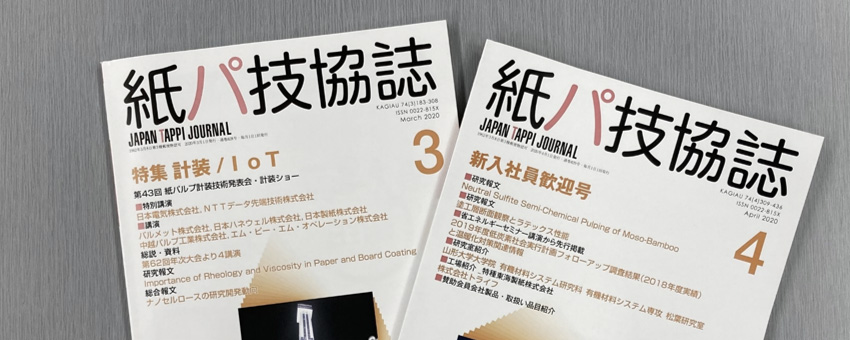
JAPAN
TAPPI JOURNALVol. 57, No.3
March 2003 Abstracts
Latest news about automation system from foreign country's references
Kiyoshi Dekula
Metso Automation K.K., Paper Automation Div.
When we started to produce "Paper" with machine. It’s control is
basically manual control or hand made ones. But as everybody can see, control/autiomation
system is totally different nowadays related with Paper Machine’s histories.
As everybody knows that Automation System defined DCS, QCS and MCS have so long
history since more than 40 years ago. In that period, there have been many progresses,
evolution and devlopment. Also Hardwares and Softwares are changing.
Based on those histories, I would like to report the latest Automation System
defined by DCS, QCS and MCS based on acrtual references.
Before introducing those refernces, I would like to express my deel appreciation
for the people who advised, informed and helped me to make this report.
New Trials Surrounding DCS
Takekazu Takayama
Oji Paper Co., Ltd., Fuji Mill
In October 2001, an innovative board machine named N-2 started up in our Oji
Paper Fuji mill. The design of control system was discussed repeatedly so as
to handle this machine very comprehensively.
During its 25 years history, DCS has grown up and well matured. Nowadays, it
seems that there left only nominal differences between one vender and another.
On the other hand, many intelligent sensor systems and information systems have
also been developed around DCS. From the viewpoint of plant operation, all the
systems should be combined and unified to serve operators like a single "seamless
system". We think that DCS is a nucleus in such system.
This paper introduces our basic idea of the control system of N-2. Whole the
scope of instrumentation system as well as some application of IT is also discussed.
A New Information System for Paper Roll Handling
Takahiro Shigematsu
Kushiro Mill, Nippon Paper Industries Co., Ltd.
This paper describes the modifications incorporated in the information system
for the existing paper roll handling process. In order to share production, marketing
and inventory information between the headquarters and each domestic mill, the
paper roll tracking system was replaced in Kushiro Mill. Since the previous system
lacked memory, communication bandwidth and expansion capacity, new PC system
was introduced. It has successfully consolidated various products information
into single database. The next phase is to expand this service to each department
by constructing company-wide LAN, and promotes the new system capability to the
headquarters.
The Performance of Sheet-break Monitoring System
Takaharu Yokota
Niigata Mill, Hokuetu Paper Industries Co., Ltd.
As a paper machines are larger and faster; even short-time sheet break causes
an enormous loss. When a sheet break occurs, it repeats frequently for the same
reason. Therefore, a prompt identification of break reasons in early stage and
working out countermeasures are of great importance in improving production efficiency.
In this report, a subject is sheet-break monitoring system. A sheet-break monitoring
system, which is an equipment identifying a breaking stage and reasons by observation
camera, is expected to reduce the sheet break.
Hokuetsu Paper, Niigata mill adopts three types of the sheet-break monitoring
systems. This report focuses on comparing functions and performances of each
system.
Integration of Control Rooms in the Power Plant and Kraft Pulp Plant by DCS
Akitosi Konno
Daishowa Paper Mfg. Co., Ltd.
To improve the productivity and to reduce the cost, Daishowa Iwanuma Mill integrated
contorol rooms in power plant and Kraft pulp plant to the central control room
respectively by introducing DCS. The project was successfully completed in a
short period the mill can spare.
This paper describes the contol system configurations and the change of operations
in both plants.
The Newest Technology of Detecting Streak and Line Fault-Algorithm of NASP-Multi
500 System-
Masayoshi Nakata
Techonology Development, Vision System Business DIV, OMRON Corporation
The measure that detects the streak fault in our company becomes about ten years.
As a trend of those days to the next of the Spot-fault inspection system, we
developed technology and products, and we developed the Streak-fault inspection
system that combined analog-processing technology and special detection algorithm.
In the performance of detecting the streak fault, the improvement was continuously
achieved up to now. The feature of the streak fault is long, slender, linear,
and that the defective signal is a minute level. So, it is beginning of the measure
that we adopted the camera and detection algorithm, which is different from these
of detecting the spot fault.
At present, using image-processing technology, we develop the detection algorithm
that suited the amount of the features of the streak fault, and have released
the products whose detection performance improved. Furthermore, the detection
algorithm has evolved by the needs of detecting the scratch fault, the line fault,
and the wrinkles fault.
Thus, it is sure that sensor technology has contributed to the base somewhat
to the demand or needs of the paper manufacture industry till present.
Advanced Technology for Streak Detection by Full-digital processing
Suzuki Satoshi
COGNEX K.K., Surface Inspection System Division
COGNEX developed a new web inspection system, "SmatView ICN". This
system has the following advanced technologies for streak detection. (1) 12 bit
digitalization (4096 gray levels) and full-digital processing, (2) Superior streak
detection algorithm, (3) Reliable Defect Identification by over 40 defect features.
It allows you to detect scratch (short streak) and moving streak.
The Newly Developed Method Applied for Streak Defects Detection
Minoru Fujita
Vision Systems Engineering, System Components Dept.
Toshiba IT-Solutions Corporation
The combination of several defect detection channels which sensitivity are optimized
for different width and length of defects is verified. The proposed width-length
defect model enables us to fully understand the characteristics of the capability
of defect detection channels. The image analysis results show that the detection
channels can enhance a streak defect.
Another important feature of defect detection is connectivity analysis, unification
and defect classification.
The newly developed web inspection system, M9000 utilizing these methods provides
various aspects of streak defect information to assist understanding of the manufacturing
process.
The Latest Technology of Detecting Streaky Flaws
Yoshinobu Sugino
Research and Development Dept., Futec Inc.
As has been the case, many requirements are made to the inspection system.
Even more diversified requirements are seen because of its possible versatile
applications. There are some industries in which , a short while back, it was
thought to be hard to apply automatic inspection, but now because of more increased
competition, some kind of automatic inspection would be a most effective means
to be apart from the other competitors. The competition is not only among domestic
but world-wide and is by all means intensifying.
As to the overall performance, there are two critical points in focus.
The first is how to most effectively utilize the flaw data for the improvement
of product quality and production yield. The inspection system was once regarded
as a simple sensor, but the times have changed now and is required to provide
an opportunity to becoming more competitive position in the market. The collected
data is thought to be even more valuable if it were shared among operators via
network. It would be further processed , like SQC analysis , to bring in more
benefit.
The second is , needless to say, the sensitivity itself. Market is going to
require defects detected which were used to be not required before. The more
sensitive means , more data is gathered.
It is crucial to make the system more efficient in handling vast flaw data along
with improved sensitivity. On top, how to most effectively share that flaw data
internally in order to achieve the better result.
Here I describe briefly about how we can achieve the afore-mentioned balanced
performance.
Introduction of Defect Inspection Systems and Their Technology
Junichi Harada
Mitsubishi Rayon Co., Ltd.
Mitsubishi Rayon has been developing and offering the optical inspection systems
using the line CCD cameras, about 10 years. These are being used for the manufacturing
processes of the optical-film, the steel or non-steel. In these fields, there
is a demand to detect the defects such as uneven surfaces and streaks, which
can be finally confirmed with the human eyes. Therefore, we have developed the
special image-processing technology to detect the defects accurately. We introduce
our image processing technology for the paper manufacturing process.
Pressure Loss Calculation Software-2002
Shigeru Saito
KITZ Corporation, Sales Engineering Dept.
We would like to introduce you new pressure loss calculation software for piping
system, which is the renewed and updated version from one of last year and easier
to use. We would like to explain to you mainly additional features from the previous
one here, not the same features. The previous software calculated fluid pressure
loss based upon virtual installation of valves and elbows on a fixed piping system.
There had been some differences from the actual piping system with this way,
which sometimes created difficulties in handling.
The new software was programmed to solve this problem. You can design plane
and lateral drawings automatically by selecting piping materials from the menu
and calculate pressure loss by setting fluid conditions at the piping system.
Thus, there is no restriction for number of piping system patterns. Users can
specify as many piping system patterns as possible.
Also you can check pressure losses at the specific locations by clicking mouse
at any points of the piping system. You can print out the whole piping system
to verify it clearly. We hope that this new software will be of great help to
you.
Automatic Friction Coefficient Testing Machine
Hirofumi Sagawa
Sagawa Seisakujo Co, Inc.
Automatic Friction Coefficient Testing Machine adapted to ISO 15359 is composed
of a main body and a personal computer instrument apparatus.
Installation of samples is more convenient by utilizing weight with clamp mechanism.
Automatic measurement will eliminate individual errors. It is highly reproducible.
New Visual Inspection System of Paper & Film-Build "Ultra-high-resolution
Visual-Inspection System" by TECHNOS Neuro-Vision5000K-
Yoshiro Yamada
TECHNOS JAPAN CORP.
The Paper Industry is known of very fast work speed as well as the cold mill
in the Steel Industry. The mass production of polarizing film and diffusion film
which will be the materials of the display device is progressing by using the
high speed production technology. TECHNOS holds a world patent of anew technology
systems. And we again developed a visual automatic inspection system which has
the best accuracy in the world. This new system is buildup a function called
Mini-Movement of human eyes. Our new system is able to find the minutest defect
to a low-contrast spot. 10000m every minute in the high speed line by only one
camera. This new system has a accuracy of 1000 times of a former CCD line camera
(equal of 4000 pixels). As we developed this marvelous system 5000K, we can deliver
within 48 hours upon receipt of an order and are able to install within 3 hours.
HBS pulping (5) -Chemical Structure and Properties of HBS Lignin-
Hideaki Nagaoka
Nippon Paper Chemicals Co., Ltd.
Yoshihiro Sano
Laboratory of Wood Chemistry, Graduate School of Agriculture, Hokkaido University
Chips of fir (T) (A. Sachalinensis Mast.) as softwood and birch (B)(B. platyphylla
var. japonica Hara) as hardwood were pulped by HBS pulping process with fresh
HBS of 1,4-butanediol and its recovered solvents (RHBS-1 and 2) prepared from
spent liquors. HBS lignins (HL), that is, BL-1-3 and TL-1-3 were isolated in
yields of 90-150% based of chips from the spent liquors of birch and fir, respectively.
Furthermore, HL was fractionated into ether insolubles (IS) and solubles (S)
to analyze. Each the lignin was subjected to elemental, spectral spectrographic
(UV and NMR), thermomechanical, gel permeation chromatographic analyses, determination
of
hydroxyl groups, and also nitrobenzene oxidation.
Keywords: Pulping with high boiling solvent, softwood, hardwood, lignin, chemical
structure, softening point, average molecular weight
Manufacturing of Magnetic Papermaking Fibers and Paper ( PartT)-Preparation of
Magnetite-Loaded Pulps at their Lumen by in situ Synthesis-
Katsuhisa Fujiwara and Masaaki Morikawa
Paper Industrial Research Institute of Ehime Prefecture
Magnetic pulps loaded with magnetite (Fe3O4) in the pulp lumen were prepared
by in situ synthesis. The synthetic conditions for forming magnetite includes
the following three steps: a) dispersion of pulp in a ferrous salt solution,
b) addition of an alkali to the ferrous salt, and c) air-bubbling. The main factors
influencing the magnetite formation were the added amount of the alkali to the
ferrous salt solution containing pulp, i.e. the pH value, and the successive
reaction temperature to form magnetite. Magnetite was formed in the temperature
range from 50 to 90°C, when the added amount of the alkali was nearly equivalent
to that of the ferrous salt present in the pulp suspension. The alkaline addition
level for magnetite formation was expanded in the range from 0.6 to 4.0 equivalent
to that of the ferrous salt at the reaction temperature of more than 90°C. The
magnetite formed in the pulp lumen was observed by means of a scanning electron
microscope. X-ray diffraction analysis of the magnetite formed in the pulp lumen
showed that it had a spinel-type crystal structure with cubic system, because
its lattice planes [311], [440] and [220] were detected at diffraction angles
2 of 35.4, 62.6 and 30.1°, respectively. The particle size of the magnetite was
0.3m on average, and distributed in the range from 0.2 to 0.4m. The magnetite
contents in the pulp were 23-33% (based on dry weight of the loaded pulps). The
magnetite-loaded pulp with 30.4% magnetite content had saturation magnetization
and remanent magnetization values of 16.3 and 3.6 emu/g of magnetite-loaded pulp,
respectively, and had a coercive force of 240 Oe.
Keywords: Magnetic paper making pulp, Magnetite-loaded pulp, Pulp lumen, in situ
synthesis, Lumen-loading
|